
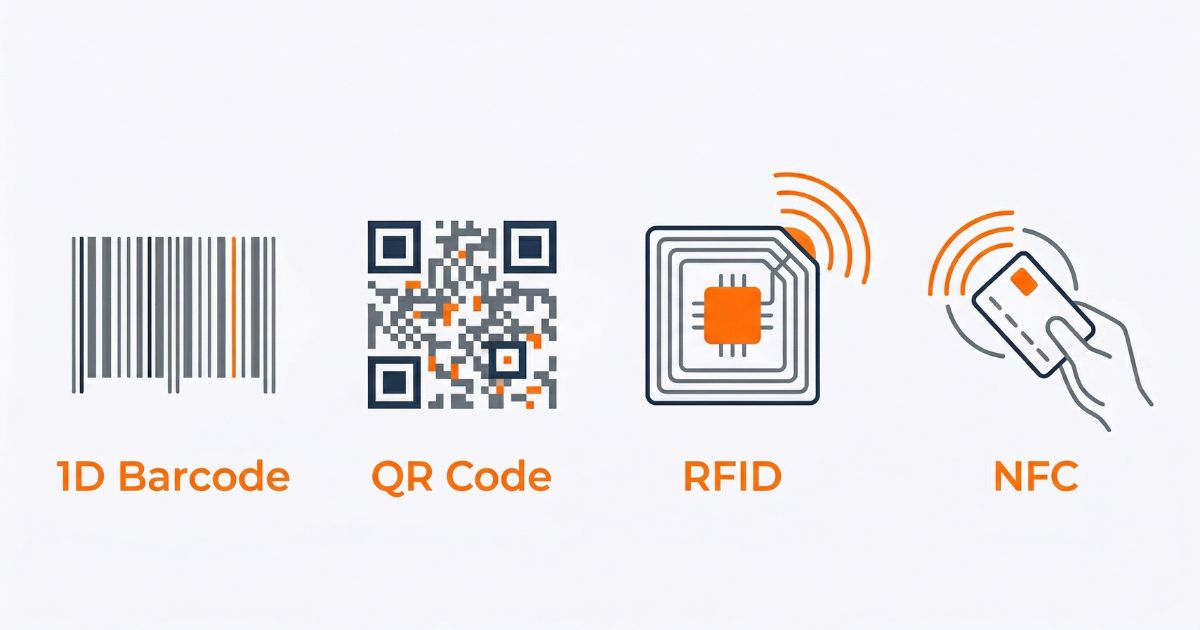
Barcode vs QR Code vs RFID vs NFC: When to Use Which
Four Technologies, One Question: Which One Does Your Operation Actually Need?
Walk into any busy distribution center, hospital stockroom, or retail backroom and you'll find at least two of these technologies in use, often more. Barcodes, QR codes, RFID, and NFC all do the same fundamental job — they capture data about a physical object and get it into a system. But that's where the similarity ends.
Choose the wrong one and you're either overspending on capability you don't need, or hitting the ceiling of a technology that can't keep up with your operation. The goal of this guide is to make the decision straightforward.
What Is a Barcode and When Does It Make Sense?
The 1D barcode — those vertical lines you've been scanning since the 1970s — remains the most widely deployed identification technology on the planet. It's fast, cheap to print, and compatible with nearly every scanner on the market.Most 1D barcode symbologies are best for relatively small amounts of data, though actual capacity varies by symbology; that is still plenty to hold a product number, SKU, or serial identifier.
Where barcodes shine: high-volume line-of-sight scanning where simplicity and throughput are the priority. Retail checkouts, warehouse receiving, outbound shipping verification — these are barcode territory. The infrastructure is inexpensive, the learning curve is minimal, and replacements are easy to print on demand.
Where barcodes struggle: anywhere you can't get a clean, direct line of sight to the label. If items are moving fast on a conveyor, stacked on a pallet, or stored in a bin where the label faces the wrong direction, you'll lose scans. Barcodes also become unreadable when they're torn, wet, or smudged — which happens in real warehouses.
QR Codes: More Data, More Flexibility — But Not Always Better
QR codes are 2D barcodes that store data both horizontally and vertically, allowing them to hold up to around 2,500 characters — roughly 200 times more than a standard linear barcode. They also have built-in error correction: a QR code can still be read even if up to 30% of it is damaged.
The bigger practical advantage is that QR codes can be scanned by any smartphone camera, eliminating the need for a dedicated scanner in consumer-facing applications. This makes them the right choice for product traceability labels, maintenance manuals, authentication, or anywhere a customer or field technician might need to access information without specialized hardware.
In industrial settings, QR codes and Data Matrix codes are widely used for direct part marking — etched or laser-printed directly onto components where a paper label wouldn't survive. For anything requiring more data density than a 1D barcode, a 2D code is the natural next step.
Where QR codes don't improve on barcodes: pure scanning speed in a high-volume industrial environment. A dedicated barcode scanner reading 1D codes is still faster and more forgiving than scanning 2D codes when throughput is the only priority.
RFID: When You Need Speed at Scale Without Line of Sight
RFID is a fundamentally different technology. Instead of using light to read a printed code, RFID readers emit radio waves that activate tags within range — and here's the critical difference: no line of sight required.
A single UHF RFID reader can capture data from hundreds of tags per second, even if those tags are hidden inside boxes, facing away from the reader, or moving quickly through a portal. In a high-volume distribution center, a fixed RFID reader at a dock door can log every pallet moving through without a single deliberate scan by a human operator.
The tradeoff is cost. An RFID tag costs anywhere from $0.10 to over $1 depending on type and volume, compared to fractions of a cent for a printed barcode label. RFID readers are also significantly more expensive than barcode scanners. The ROI calculation needs to account for this, and it typically only works out in high-value asset tracking, high-volume logistics automation, or operations where missing a scan has significant downstream consequences.
RFID also has physical limitations. Metal surfaces and liquids can interfere with radio wave transmission — something to account for in environments where products are metallic or liquid-filled.
NFC: Built for Short Range, High Trust
NFC is technically a subset of RFID, operating at 13.56 MHz with a read range of roughly 1–4 centimeters. That extremely short range is both its limitation and its deliberate design feature.
The close-proximity requirement makes NFC ideal for applications where intentionality matters: contactless payments, access control, asset check-in/check-out, and product authentication. The user has to bring their device close to the tag, which reduces false reads and supports secure transactions.
In industrial and logistics contexts, NFC is rarely the right primary scanning technology — it's too slow and too close-range for high-volume operations. But it has a clear role in applications like tool check-out systems, controlled access to equipment, or anti-counterfeiting on high-value products.
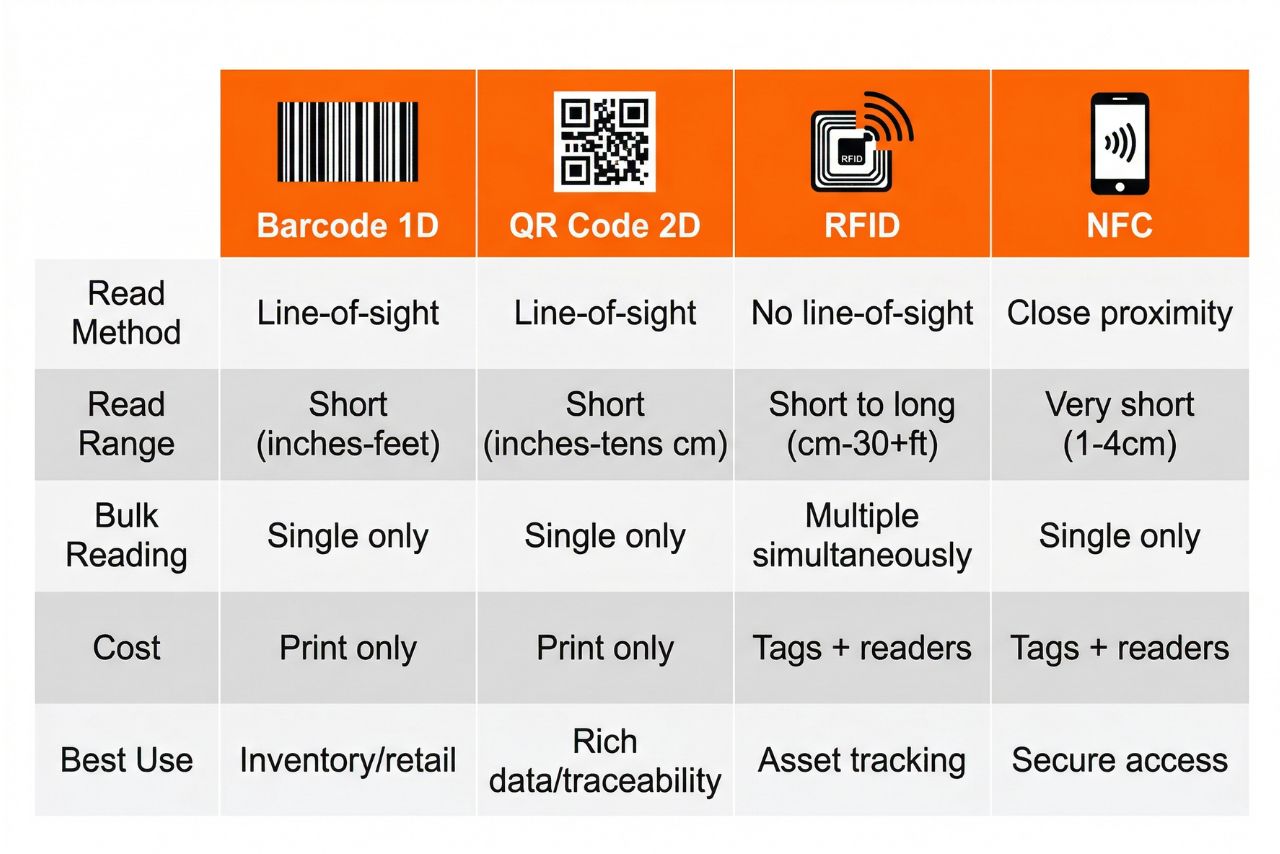
Side-by-Side: How to Choose Between the Four
| Barcode (1D) | QR Code (2D) | RFID | NFC | |
|---|---|---|---|---|
| Read method | Line of sight | Line of sight | No line of sight required | Tap / close proximity |
| Read range | Inches to a few feet | Inches to tens of centimeters | Varies by frequency and setup; from centimeters to 30+ ft | ~1–4 cm |
| Bulk reading | One at a time | One at a time | Hundreds per second | One at a time |
| Data capacity | Varies by symbology; typically limited | Varies by content and version; can hold substantially more than 1D | Varies by tag | Varies by tag |
| Hardware cost | Very low | Very low (smartphone) | Medium–high | Low–medium |
| Tag/label cost | Very low | Very low (print) | $0.10–$1+ per tag | $0.20–$2+ per tag |
| Best for | High-volume line scanning | Consumer apps, traceability, richer data | Asset tracking, bulk logistics | Access control, payments |
A few rules of thumb that hold up in practice:
- If your primary requirement is fast, high-volume line scanning of labeled items in a controlled environment — barcode is usually the right answer.
- If you need more data per code, damage tolerance, or smartphone readability — move to QR or Data Matrix.
- If you need bulk scanning, no line of sight, or automation at scale — evaluate RFID seriously, and run the numbers on tag cost vs. operational gain.
- If you need secure short-range interactions, access control, or authentication — NFC has a legitimate role.
These technologies are also not mutually exclusive. Many operations run barcodes or 2D codes for routine scanning and RFID for high-value asset tracking simultaneously.
The Bottom Line
The right technology is the one that matches your operational reality — not the one with the most impressive spec sheet. For most business-to-business operations moving physical goods, barcode and QR code scanning covers the majority of use cases at the lowest cost and complexity. RFID makes sense when scale, automation, or no-line-of-sight requirements push you past what optical scanning can deliver.
Once you've identified which technology fits your environment, the next question is which hardware to select. That's exactly what the Buyer's Guide section of this site is designed to answer.